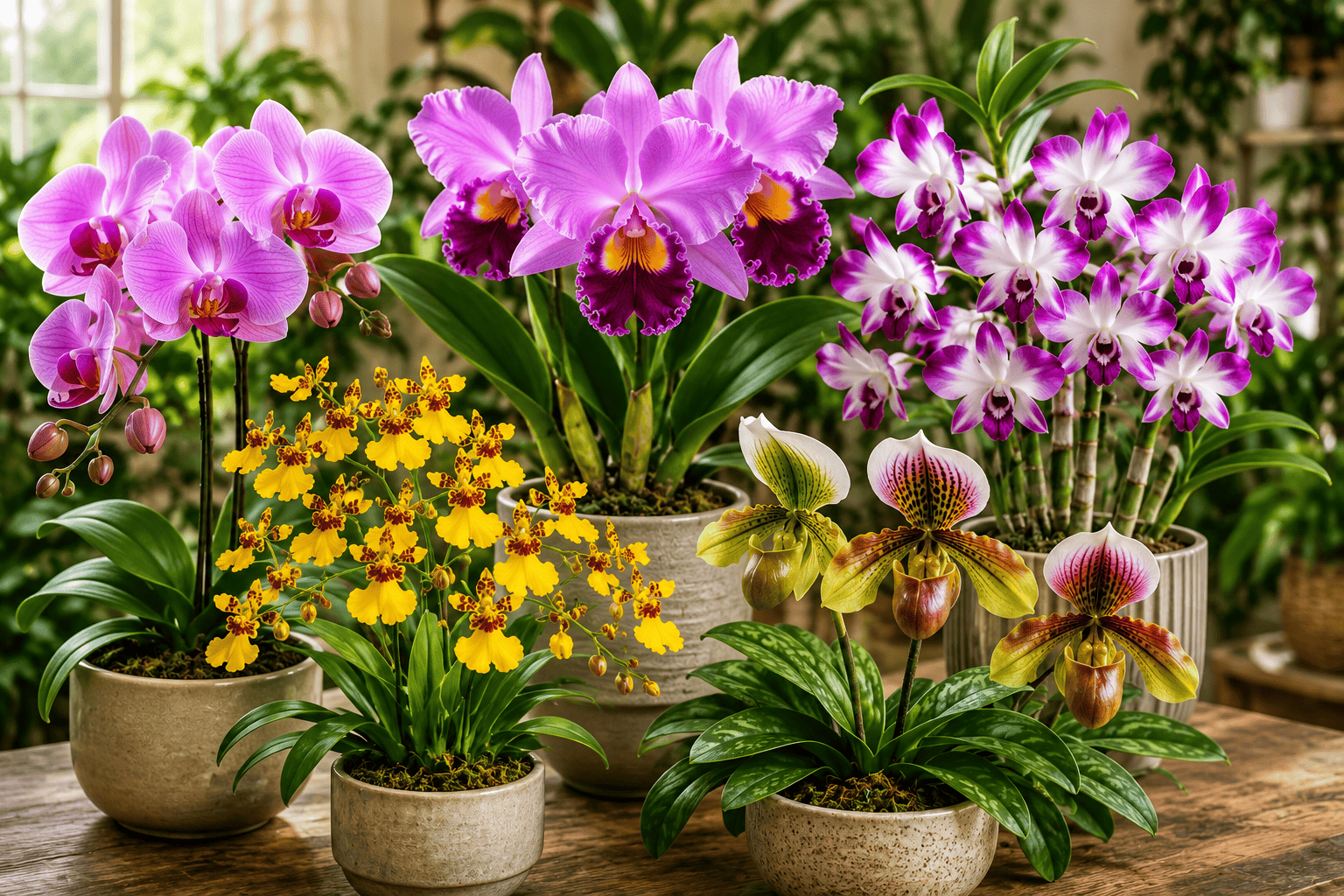
Orchids are some of the most diverse and captivating plants in the world. With thousands of different types of orchids, each has its own distinctive shape, color, and fragrance. While some orchids are relatively easy to grow indoors, others need extra care and experience — but every variety can add a touch of elegance and beauty to your home.
In this blog post, we’ll explore 20 of the best types of orchids to grow as houseplants. We’ll also share helpful care tips, including watering, fertilizing, repotting, and pruning, to help you keep your orchids healthy and thriving.
One important detail you’ll discover about each orchid is whether it is classified as a warm, intermediate, or cool grower. This will give you a better idea of the temperature conditions each variety needs to grow well.
- Warm growers prefer daytime temperatures between 70 and 90°F, with nighttime temperatures ranging from 60 to 75°F.
- Intermediate growers do best with daytime temperatures of 65 to 80°F and nighttime temperatures between 55 and 70°F.
- Cool growers thrive in daytime temperatures of 60 to 75°F, with nighttime temperatures ranging from 50 to 65°F.
Table of Contents
ToggleBest Types of Orchids to Grow:
1. Moth Orchid (Phalaenopsis)
Moth orchids are considered one of the easiest orchid varieties to grow and are widely available. You might even find one at your nearby supermarket!
These are native to tropical and subtropical regions of Asia and Australia. The Phalaenopsis genus includes around 78 species, along with numerous natural and cultivated hybrids.
Commonly known as moth orchids, these plants are mostly epiphytes, meaning they grow on other plants, although some species grow on rocks or directly in the ground.
Often affectionately called “Phals,” these orchids have a monopodial growth habit, with large, fleshy leaves that help store water. Their leaves are usually medium to dark green on top, while the undersides may have a maroon tint.
Including their arching flower spikes, moth orchids can grow up to three feet tall. Their large, beautiful blooms typically appear from late winter through spring and come in shades of white, yellow, pink, peach, and purple. The flowers can last for several months, and some varieties also have a lovely fragrance.
Moth orchids are relatively easy to grow under normal household conditions and are classified as intermediate to warm growers.
They are also quite adaptable when it comes to lighting and can thrive in low, medium, or bright indirect light.
Keep the potting medium slightly moist. Allow it to dry almost completely between watering. These orchids also prefer humidity levels between 40 and 80 percent.
Since their roots can carry out photosynthesis, moth orchids are commonly grown in clear plastic pots that allow light to reach the roots. However, they can also be grown in baskets.
2. Cattleya Orchid (Cattleya)
The Cattleya genus includes more than 120 species, along with numerous natural and cultivated hybrids, originating mainly from South America.
They are known for their large, colorful, and eye-catching blooms. These orchids grow on trees or rocks and develop pseudobulbs that help store water and nutrients.
Cattleyas have thick, leathery, medium-green leaves that are usually oblong in shape. Most plants grow up to two feet tall, although some hybrids remain more compact.
These orchids are generally divided into two types: unifoliate, which produces one leaf per pseudobulb, and bifoliate, which develops two leaves per pseudobulb.
Unifoliate Cattleyas typically produce flowers in shades of violet, lavender, and white, while bifoliate varieties often feature blooms in mahogany, purple, green, yellow, and orange.
Their flowers are usually large, fragrant, and funnel-shaped.
Cattleya orchids are mainly intermediate growers, although some species and hybrids prefer warmer conditions. They generally do well in daytime temperatures of 70 to 85°F and nighttime temperatures between 55 and 60°F. They can also tolerate higher daytime temperatures when provided with some shade.
These orchids love bright light and benefit from a few hours of direct sunlight in the morning or late afternoon. However, it’s best to protect them from strong midday sun to prevent leaf damage.
They prefer a humidity level between 40 and 80 percent.
Allow the potting medium to dry almost completely between waterings. During winter, reduce watering to help prevent root rot.
Cattleyas can be grown in pots or baskets, or mounted on pieces of wood or cork, depending on the growing conditions and available space.
With so many species and hybrids to choose from, Cattleya orchids vary in their care requirements and difficulty levels. In general, hybrids tend to adapt better to indoor growing conditions than many species.
3. Dendrobium
Dendrobium is a highly diverse genus containing at least 1,600 different species, with native habitats spread across Asia and Australia.
These sympodial orchids produce small or large blooms, with some lasting only a few days and others remaining for weeks, depending on the species or hybrid.
Some dendrobiums are suitable for beginner growers, while others are better suited to more experienced orchid enthusiasts.
As they have a wide range of habitats, it is difficult to briefly generalize about the growth characteristics or how to care for orchid plants in this genus.
Let’s talk about one easy species of Dendrobium – Den. kingianum. It is one of the easiest to find and care for as a houseplant. It is also known as the “pink rock orchid”. This lithophyte adapts well to both cool temperatures and extreme heat.
For best results, grow it as a cool grower, providing bright indirect light, at least 50 percent humidity, and water when the potting medium begins to dry out.
A cool period in late fall with reduced watering will encourage flower production.
There are many forms and cultivars of this species, with flowers in shades of white, pink, mauve, purple, and yellow. The blooms are fragrant and long-lasting on compact plants.
4. Oncidium (Dancing Lady Orchid)
Oncidiums, or “dancing lady orchid,” produce delicate, airy sprays of warm-colored flowers. They have over 330 species native to Florida, Mexico, Central America, South America, and the West Indies. They grow in various habitats, although most are tropical or subtropical.
Oncidiums are sympodial orchids with water-storing pseudobulbs. Some varieties have thick, fleshy leaves, while others have thin ones.
Their flowers come in shades of yellow, brown, and maroon, often featuring spots or markings.
As Oncidium has many different species, growing needs vary between species and hybrids.
Oncidiums are considered intermediate to warm growers and need bright light, ideally with at least an hour of direct sunlight daily. Thick-leaved varieties can tolerate more direct sunlight. Thin-leaved species need more frequent watering than fleshy-leaved ones. Generally, allow the potting medium to dry about halfway between waterings.
Some varieties have a winter rest period, during which they need less frequent watering than during the growing season.
They prefer humidity between 30 and 80 percent. Accordion-like folds in the leaves may indicate that the plant needs more humidity.
More drought-tolerant species can be mounted, while those grown in pots should be kept in small containers to help prevent root rot.
Oncidiums are generally easy to care for, even for beginner orchid growers.
If you’d like to try this genus, consider Onc. Rex’s Luck ‘Firefly,’ a mildly fragrant hybrid with curled or wavy purple and white petals and sepals, complemented by a bright yellow spot on its maroon lip.
5. Paphiopedilum (Lady’s Slipper Orchid)
Paphiopedilums, often called “paphs” for short, are native to tropical regions of Asia. The Paphiopedilum genus includes over 100 species, along with numerous hybrids.
These are also known as “lady slippers,” “Venus slippers,” or “slipper orchids,”. These plants are named after the distinctive shape of their flower lips. They are mostly terrestrial, although some grow on rocks or trees.
Paphiopedilums are sympodial orchids without pseudobulbs. They produce a fan of three to eight leaves, which are generally short and strap-shaped. Their leaves may be solid green or mottled with light and dark green, sometimes with purple undersides.
These plants can grow up to two feet tall, including their flower spikes. Each spike produces one or more large, attractive blooms in shades of green, pink, burgundy, yellow, ivory, or brown.
The flowers often feature lines, spots, and veins across their petals, sepals, and lips.
Paphiopedilums with solid green leaves and a single flower per spike prefer intermediate temperatures, while those with mottled leaves or multiple flowers generally prefer warmer conditions.
Unlike some orchids, they don’t need as much light and grow well in medium, indirect light.
Since paphiopedilums lack water-storing pseudobulbs, they should never be allowed to dry out completely. Keep the potting medium moist but not waterlogged, and water when its surface feels dry to the touch.
Lady slippers need humidity levels of at least 50 percent. They grow well in plastic or clay pots, and should be repotted annually. Learning how to repot an orchid can help you refresh the growing medium and maintain healthy root growth.
Some paphiopedilums are easy types of orchids to grow as houseplants for beginners, while others are better suited to intermediate or experienced orchid growers.
If you’re new to growing these orchids, choose a mottled-leaf species or hybrid, such as Paph. callosum.
6. Cymbidium (Boat Orchid)
Cymbidium orchids are native to tropical and subtropical areas of Asia and Australia. They are commonly known as “boat orchids” because of the shape of their flowers’ lips.
The Cymbidium genus contains approximately 85 species, including sympodial epiphytes, lithophytes, and terrestrial orchids. Many hybrids and miniature varieties are also available.
These orchids produce grass-like or strap-shaped leaves in shades of medium to golden green. In most species, the leaves grow from elongated or oval pseudobulbs.
These plants can be compact or large and can reach up to three feet in height.
Cymbidium flowers vary in size. Some varieties produce small flowers while others develop large ones. Some flowers are fragrant and typically appear in shades of white, yellow, green, pink, and red.
Large-flowered varieties prefer cool growing conditions, while small-flowered tropical and subtropical types thrive in warmer temperatures. Some small-flowered terrestrial species from temperate regions also prefer cool, moist conditions.
If you’re unsure which type you have, most cymbidiums can be grown under intermediate conditions. These orchids grow well in bright, direct light, but strong midday sunlight should be avoided.
Keep the growing medium moist. Water once the top one or two inches becomes dry. They also prefer humidity levels between 40 and 70 percent.
Cymbidiums can be grown in pots. Planting them in baskets often works better for varieties with trailing flower spikes.
Cymbidiums are suitable for beginners, and a good variety to start with is Cym.
This hybrid prefers warm conditions and doesn’t need cooler winter temperatures. Its fragrant white flowers appear in summer or fall and can last for around a month.
7. Brassia (Spider Orchid)
Brassias are native to tropical regions of the Americas. They have over 68 species, most of which are epiphytes.
They are commonly known as “spider orchids,”.These sympodial plants have flattened green pseudobulbs that often feature a reddish tint.
Their leaves are yellowish-green and range from linear to oblong or strap-shaped, while the plants themselves vary in size from small to large.
Brassias produce multiple fragrant flowers on arching spikes, usually in shades of green, yellow, or tan.
The flowers have thin, wispy petals and vary in size depending on the species or hybrid, with some producing particularly large blooms. They generally flower in spring or summer and may bloom more than once a year.
Depending on the species or hybrid, they can be cool, intermediate, or warm growers and prefer humidity levels between 50 and 70 percent.
These orchids typically need bright, filtered light and can grow well on lightly shaded, south-facing windowsills.
Brassias are relatively easy for beginners to grow and can be cultivated in pots filled with orchid potting mix or mounted.
For potted plants, water when the surface of the growing medium feels dry to the touch. They need watering roughly once a week from spring through autumn and less often during winter.
On the other hand, mounted plants may need watering about every other day.
If you’re looking for a Brassia to grow, Brs. verrucosa is one species worth considering.
It produces sprays of 10 to 20 light green to yellow flowers speckled with reddish-brown markings. Its long, slender petals and sepals give the blooms their distinctive spider-like appearance.
Brs. verrucosa is an intermediate grower that prefers low to medium light. Its fragrant flowers measure eight to 10 inches across, bloom between spring and fall, and can last up to eight weeks.
8. Vanda
Vanda is native mainly to low-altitude regions of the subtropics and tropics. This genus includes 85 species found across Asia and Australia.
These monopodial orchids have large aerial roots and naturally grow on trees or rocks. Most are tall plants, with the largest species reaching up to six feet, while some grow only a few inches tall.
Their leaves vary in shape. Some are strap-shaped and leathery, others have terete (pencil-shaped) leaves, and some feature semi-terete foliage. Their leaves are generally medium green.
The flowers are usually large and showy. They come in a wide range of colors and may feature checkerboard or mosaic patterns, as well as spots.
Vandas can bloom throughout the year, and their flowers may last from a couple of weeks to several months. Some varieties are also fragrant.
These orchids grow best in greenhouse conditions, but you may be able to grow them successfully as houseplants if you can provide the intense light and high humidity they need.
Most Vandas are intermediate to warm growers and can tolerate daytime temperatures of up to 95°F.
They require bright, intense light. Pencil-leaved varieties need up to six hours of direct sunlight daily, while strap-leaved types should be protected from direct midday sun.
Vandas generally don’t grow well in pots, so they are usually kept in slatted baskets that allow plenty of airflow around the roots and room for flower spikes to hang down.
These orchids need frequent watering or misting and prefer humidity levels of around 80 percent.
During warm weather, they need watering multiple times. While in cooler conditions, they need less frequent watering.
9. Zygopetalum
Zygopetalum orchids are native to South America. This genus includes 15 or 16 species of large, sympodial epiphytic or terrestrial orchids.
They produce pseudobulbs with fans of light green, strap-shaped leaves featuring lighter veins.
Their flowers range from small to large and are generally green with maroon markings and a prominent lip in a contrasting color. The flowers are fleshy and often have leopard-like spots. They typically flower in winter or early spring. Their flowers last 2 to 3 months, and some varieties are often fragrant.
Zygopetalums are intermediate growers that prefer bright, indirect light, although they can tolerate some direct sunlight in the early morning or late afternoon.
They prefer a humidity level of at least 50 percent and a slightly moist potting medium. These orchids need plenty of water during active growth and less when resting.
Zygopetalum orchids require fairly large pots to accommodate their extensive root systems.
These plants are relatively easy to care for, so they’re ideal for beginners.
10. Ludisia (Jewel Orchid)
Ludisia, commonly known as “Jewel orchids,” is known for their beautifully patterned leaves rather than their flowers.
The genus contains only two species: Lus. discolor, native to China, Indonesia, and other parts of Southeast Asia, and Lus. ravinii, which is native to the Philippines.
These terrestrial or lithophytic orchids have a sympodial growth habit and oval-shaped leaves that range from dark green to brownish-purple, with contrasting veins in shades of gold to red.
These orchids grow to around 10 inches tall, including their flower spikes, which carry small, mildly fragrant white or pink blooms. The flower spikes may grow upright or trail downwards, usually producing flowers during the winter months.
These orchids are intermediate growers and thrive in medium, indirect light. They are also relatively easy to water because their watering needs remain consistent throughout the year.
Keep the potting medium evenly moist, and never allow it to dry out completely, as these plants lack pseudobulbs for storing moisture.
They prefer humidity levels ranging from 40 to 80 percent.
Because of their creeping growth habit, jewel orchids grow best in wide, shallow pots.
Lus. discolor is the one that you’re most likely to find for growing as a houseplant.
11. Encyclia
Encyclia orchids are epiphytes that grow naturally in habitats ranging from hot, dry regions to misty rainforests.
The genus includes approximately 171 species native to Mexico, Central America, South America, and the West Indies. They vary in size, growing from just two inches to over two feet tall.
These sympodial plants produce fleshy, strap-shaped leaves from their pseudobulbs and develop flowers in shades of green, brown, maroon, or white.
Each flower spike usually carries a dozen or more blooms, with individual flowers measuring one to two inches across.
Encyclias are mostly intermediate to warm growers, although some varieties prefer cooler conditions. They need good air circulation and bright to very bright, filtered light.
Allow the potting medium to dry between waterings. These orchids prefer drier conditions during winter, but watering should be increased when new growth begins.
Encyclias need moderate humidity levels of 40 to 70 percent, with slightly higher humidity during the growing season than in winter.
These orchids can be grown in small clay or plastic pots or mounted, making them an excellent choice for beginners.
One variety worth trying is E. cordigera, which produces fragrant flowers that can last for up to three months.
There are several cultivars of E. cordigera, featuring combinations of dark mahogany petals and sepals with a white, pink, or purple lip.
12. Coelogyne
When many of us think of orchids, we picture a flower spike with a single, striking, large bloom, or perhaps a few large flowers.
If that’s also the case for you, some members of the Coelogyne genus (pronounced “see lodge eh nee”) may change this common perception!
Many species in this genus have a strong visual impression with trailing flower spikes densely covered in clusters of small blooms, particularly those previously classified as Dendrochilum species.
They were reclassified in 2021, and formerly known Dendrochilum species are commonly called “golden chain orchids” or “fox brush orchids,” referring to their dense flower sprays. Their blooms are usually white, tan, or green.
The Coelogyne genus includes over 595 species from India, New Guinea, and Southeast Asia.
These sympodial orchids are mostly epiphytes and have oval pseudobulbs.
Most Coelogynes are intermediate growers that do well in medium to bright, indirect light. In summer, they need high humidity levels of around 85 percent, while in winter, humidity should be reduced to between 60 and 70 percent.
Water them when the potting medium begins to dry out, but before it dries completely. These orchids also need a short winter rest period, with less frequent watering.
Coelogynes are grown in pots and are considered easy to cultivate, even for beginners.
If you’re looking for a starter plant, try Coel. wenzelii, an epiphyte that produces reddish-orange flowers in winter and grows well in warm conditions with low to medium, indirect light.
13. Bulbophyllum
Bulbophyllum is a very large genus, with over 2,000 orchid species native to tropical and subtropical regions of Asia, Oceania, Africa, and the Americas.
Although some are lithophytes, most Bulbophyllum species are epiphytes. They have pseudobulbs to store water, and their slightly cupped leaves can be thin, leathery, or fleshy.
Bulbophyllum species have light to medium green foliage, and the genus includes both evergreen and deciduous plants.
With so many different species, this genus shows great diversity – some have flowers easily recognized as orchids, while others look surprisingly unlike typical orchid blooms.
Plants range from very small to very large, and while many species produce fragrant flowers, some have an unpleasant odor meant to attract their main pollinators – flies.
Most of these orchids are intermediate growers, although some prefer warm conditions while others thrive in cooler environments.
They grow well in moderate to bright, indirect light.
Some species can be grown in shallow pots, while those with long rhizomes tend to do better in baskets or mounted on slabs. As fast growers, their roots can be difficult to contain.
Bulbophyllums need humidity levels between 50 and 70 percent and require plenty of water. Mounted plants usually need daily watering, while potted ones need watering a few times a week.
Some species need a winter rest period with reduced watering or no water at all.
Bulbophyllums can be a little challenging, so if you’re a beginner orchid enthusiast, you may prefer some of the other, beginner-friendly genera recommended in this article.
For intermediate and advanced orchid lovers ready to try growing the unusual blooms of bulbophyllums, Bulb. Frank Smith is a hybrid worth considering.
14. Epidendrum
If you thought Dendrobiums were a diverse group, meet Epidendrum, a genus containing over 1,700 species.
Also known as “crucifix orchids,” this highly varied genus includes species native to Central America, Mexico, South America, and the United States.
These sympodial plants are either epiphytic or terrestrial, and the Epidendrum genus includes both miniature species and giants that grow up to six feet tall, along with many sizes in between.
Most epidendrums produce cane-like pseudobulbs or reed-like stems.
Their blooms are long-lasting and often red, magenta, orange, or green, but the flowers can appear in almost every color of the spectrum except black and cyan blue.
Most epidendrums prefer intermediate temperatures, while others thrive in cool or warm conditions, depending on the species.
They need bright light, humidity levels between 50 and 80 percent, and should be allowed to dry out completely between waterings.
Epidendrums are evergreen and keep growing throughout the year, although some prefer a rest period with cooler, drier conditions during winter.
Crucifix orchids can be grown in pots filled with a coarse potting medium, while smaller specimens can also be mounted.
Growing epidendrums is simple enough for even beginner orchid growers.
With so many options available, here’s one to consider: Also called the “fire star orchid” or “poor man’s orchid,” Epi. radicans is a terrestrial orchid with reed-like stems and fiery, dark reddish-orange and yellow blooms.
Epi. radicans prefers warm temperatures and should be watered about once a week.
15. Brassavola (Lady Of the Night)
Brassavola is a genus comprising approximately 20 species, native to tropical regions of Central America, South America, and the West Indies.
These orchids are are epiphytes or lithophytes and are sympodial, with cylindrical leaves and pseudobulbs that help store water.
These fleshy leaves are usually long and tapering. They’re generally green and sometimes speckled with red.
Brassavola plants have a hanging growth habit and produce blooms in shades of white and greenish white, a common feature of flowers pollinated at night by moths.
The flowers are showy, with large, ruffled or lobed lips. They bloom mainly during summer and release their fragrance at night.
Brassavolas need bright light. Although mostly indirect light is suitable, they also benefit from a few hours of direct sunlight each day.
These orchids are warm to intermediate growers and tolerate low humidity much better than many other varieties, requiring levels of just 30 to 50 percent.
You can mount these orchids or grow them in baskets or pots. Make sure the potting medium has excellent drainage.
Let potted plants dry out between waterings, while you can soak basket-grown or mounted orchids for 15 minutes about once a week.
Brassavolas are easy-care houseplants, and encouraging these orchids to bloom again is not difficult. However, keeping an eye out for problems with orchid growth can help you address any issues early.
16. Rhynchostylis (Foxtail Orchid)
Rhynchostylis orchids are also known as “foxtail orchids”. This genus contains only five species, all native to Asia.
These tropical orchids are epiphytic or lithophytic, have monopodial growth, and feature fleshy, leathery, strap-shaped leaves.
Their flower sprays are arching or hanging and carry showy, highly fragrant blooms in shades ranging from white to magenta, often marked with bold red or purple spots.
These intermediate to warm growers need bright, indirect light and humidity levels of around 75 percent.Water them daily if you grow them mounted or in baskets.
For potted plants, water when the growing medium starts to dry out. During flowering, keep the growing medium moist..
Outside the growing season, let these orchids rest in drier conditions and grow them in hanging baskets or on mounts.
Due to their somewhat demanding care requirements, beginners may want to wait until they have gained more experience with orchids before trying these varieties.
17. Calanthe
Calanthe is a genus of mostly terrestrial orchids that was expanded in 2020 to include several reclassified genera, including Phaius.
The genus now contains 275 sympodial species native to tropical and subtropical regions of Africa, Asia, the Americas, and Oceania.
These are divided into two types of orchids: deciduous and evergreen.
Evergreen calanthes lack pseudobulbs, while these are prominent in deciduous varieties. Both types produce large, pleated leaves.
Flower spikes usually appear in winter, with blooms in shades of white, orange, brown, yellow, pink, purple, or bluish purple that last for a month or longer.
Depending on the species or hybrid, a calanthe may be a cool, intermediate, or warm grower. All types thrive in bright, indirect light.
Evergreen species need a consistently moist potting medium throughout the year, while deciduous types should receive less water during winter dormancy, just enough to prevent their pseudobulbs from shriveling.
Beginner orchid enthusiasts will likely find evergreen Calanthes easier to grow before moving on to the more challenging deciduous types.
One variety to start with is Cal. tankervilleae, also known as the “greater swamp orchid.” This evergreen, terrestrial, warm-growing species blooms in spring or early summer.
Its petals are white on the outside and brownish purple on the inside, surrounding a tubular purple lip.
18. Laelia
The Laelia genus consists of 24 species native to Mexico, the West Indies, and Central and South America.
These sympodial epiphytic and lithophytic plants have pseudobulbs and leathery or fleshy leaves, which sometimes feature a purplish tint.
Laelias produce star-shaped blooms in bold colors, although white and purple flowers are the most common.
Species in this genus are generally considered intermediate growers, but growing conditions vary among different types.
In general, these orchids need moderate to bright light, plenty of water during the growing season, and slightly drier conditions during winter dormancy.
Allow the plants to dry out between waterings and keep them a little drier after flowering. Maintain humidity levels between 50 and 70 percent.
Most laelias grow well in pots, although some are better suited to baskets.
- purpurata var. striata ‘Stars and Bars’ x var. flamea produces clusters of three to five large flowers. These are white with a bright pinkish-purple lip and pink stripes on the petals and sepals.
The flowers measure five to seven inches across and bloom in spring or summer.
19. Miltonia
With their star-shaped blooms, Miltonias are native to South America, primarily Brazil.
The genus includes just 12 species and four natural hybrids, but there are also many interspecies and intergeneric Miltonia hybrids.
Miltonia species are sympodial and produce pseudobulbs along creeping rhizomes, with linear or strap-shaped leaves that are folded down the middle.
These epiphytic plants grow to around 20 inches tall and produce flower spikes bearing one to 12 blooms. The flowers typically have pointed petals and sepals surrounding a large lip.
These warm-growing orchids need bright light and humidity levels between 60 and 75 percent. Their leaves may develop accordion-like folds when humidity is too low.
Miltonias need plenty of water during the growing season and less while resting. Allow them to dry out almost completely between waterings.
They are beginner-friendly and can be grown in wide, shallow pots, baskets, or mounted.
Milt. spectabilis is a good species to start with and is available in wide, beautiful varieties and crosses from nurseries.
20. Cycnoches (Swan Orchids)
Cycnoches are also known as “swan orchids” because of the shape of their flowers. They have 33 species native to Central and South America.
These sympodial plants produce conical or spindle-shaped pseudobulbs. Plants maintain only three pseudobulbs at a time, with the oldest dying back as a new one develops.
Swan orchids are deciduous and have thin, pleated leaves.
The leaves fall after flowering, leaving only the pseudobulbs, which can make a Cycnoches plant look more like a cactus than you might expect from an orchid.
Cycnoches produce hanging sprays of highly fragrant flowers, usually in shades of red, bronze, white, yellow, or green.
Blooms generally appear in fall, with flower size varying according to the species or hybrid.
Swan orchids prefer warm conditions from spring through autumn and intermediate temperatures during winter.
Provide bright, indirect light, along with some direct morning sunlight.
As deciduous plants, cycnoches orchids have changing water needs throughout the year. They require plenty of water during the growing season, followed by a drier rest period.
Cycnoches thrive in humidity levels between 50 and 70 percent and you can grow them in pots or mounts.
These deciduous orchids are easier to grow for intermediate and advanced hobbyists. When you’re ready to try one, Cyc. warscewiczii is an excellent species to consider.
With its upside-down, fragrant flowers, this species features greenish-yellow petals and sepals surrounding a white lip.